How Beauty Brands Are Messaging Black Friday 2026: Discounts, Bundles and Free Gifts
By Daniel Romano, Founder & CEO, Good Moose · Updated
Beauty brands are not competing on bigger numbers this Black Friday. Headline discounts held in the 20% to 30% range, and the real differences came from how brands packaged and messaged the offer. In the offers we tracked, beauty used bundles at roughly three times the rate of other DTC categories, and only about 36.5% of beauty offers relied on a flat sitewide percentage alone.
Good Moose's expertise is growth marketing for beauty brands, so with our partner DTC Calendar we looked at how beauty brands messaged their homepages between November 14 and 26, 2026. Below, we break down the messaging strategies brands leaned on: the sitewide percentage, bundles and sets, gifts with purchase and the layered offers that combined them. For each, we share real examples and what it costs in margin.
The short answer: Beauty's Black Friday 2026 messaging was built on three levers. A sitewide percentage, usually 20% to 30%, set the headline. Bundles and sets carried the deeper numbers. Gifts with purchase rewarded shoppers for reaching a spend threshold. Several brands layered two or three of these into one offer.
Observation cutoff: November 26, 2026. Black Friday falls on November 27 and Cyber Monday on November 30. Offers can change before and during the weekend.
Key findings
- Headline discounts held steady. Going into Thanksgiving, headline discounts stayed in the 20% to 30% range. Brands added gifts and spend thresholds instead of deeper cuts.
- Beauty leans on offer structure. About 13.5% of tracked beauty offers were bundles or routines and 7.9% were gifts with purchase.
- Bundles are far more common in beauty. Across other DTC categories, bundles made up about 4.5% of offers and gifts about 2.2%, so beauty uses bundles at roughly three times the rate.
- Flat sitewide discounts were the minority. Only about 36.5% of beauty offers relied on a flat sitewide percentage alone.
- Early access peaked before the weekend. Early access messaging peaked earlier in the week and fell sharply on Thanksgiving morning as brands switched to public Black Friday banners.
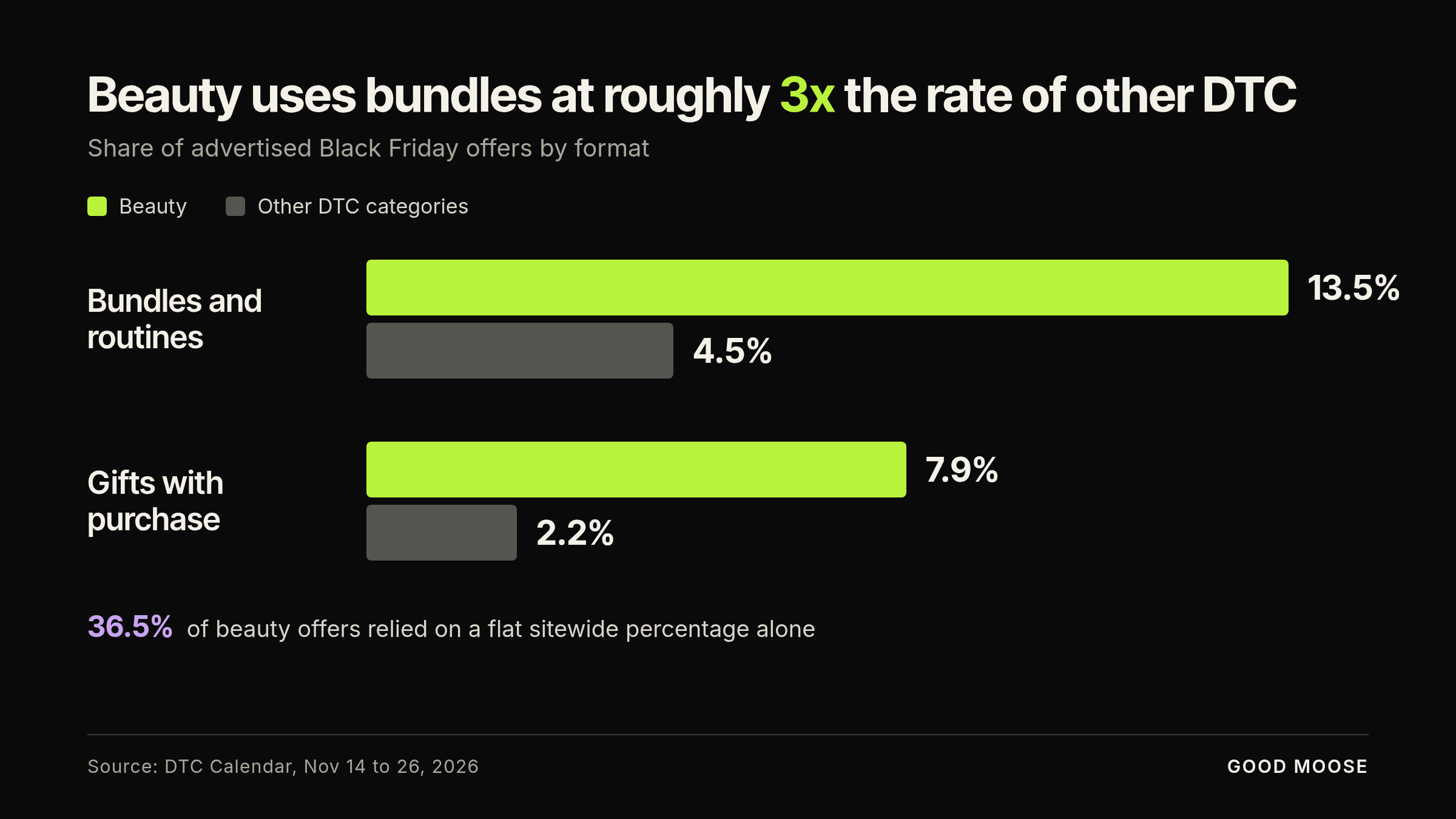
Source: DTC Calendar, Nov 14 to 26, 2026. Share of advertised beauty offers by format among tracked brands.
Why packaging matters more than the number
With Black Friday 2026 falling on November 27, most beauty brands locked their headline number well before the week began. What sets offers apart is how that number is packaged. A 25% discount, a 40% off set and a free full size product at $90 can cost a brand similar margin, but they send very different signals to the shopper and build very different baskets.
Beauty has an advantage here. Customers replenish favorites, buy gifts and try new products in the same season, which gives brands more ways to message value than a deeper price cut. It also shifts the goal from one discounted order to customer lifetime value: a shopper who discovers a product in a set or as a gift can come back to replenish it at full price.
Messaging strategy 1: Lead with a sitewide percentage
The message: One clear percentage across the range, usually 20% to 30%.
Who led with it: Paula's Choice advertised 30% off sitewide with code CYBER26, Cocokind 25% off everything, Dae Hair 30% off sitewide, Briogeo 30% off sitewide with no code needed and Phlur 20% off everything.
Why brands use it: It is the easiest offer to understand and the simplest to carry across ads, email and the homepage banner. It suits brands with strong hero products, high repeat purchase and an audience that waits for the annual sale.
The cost behind it: Every unit carries the same margin cost, including products people would have bought anyway. On a $100 product with a 70% gross margin, moving from 20% to 30% off cuts gross profit per unit from $50 to $40. You need 25% more units to earn the same profit.
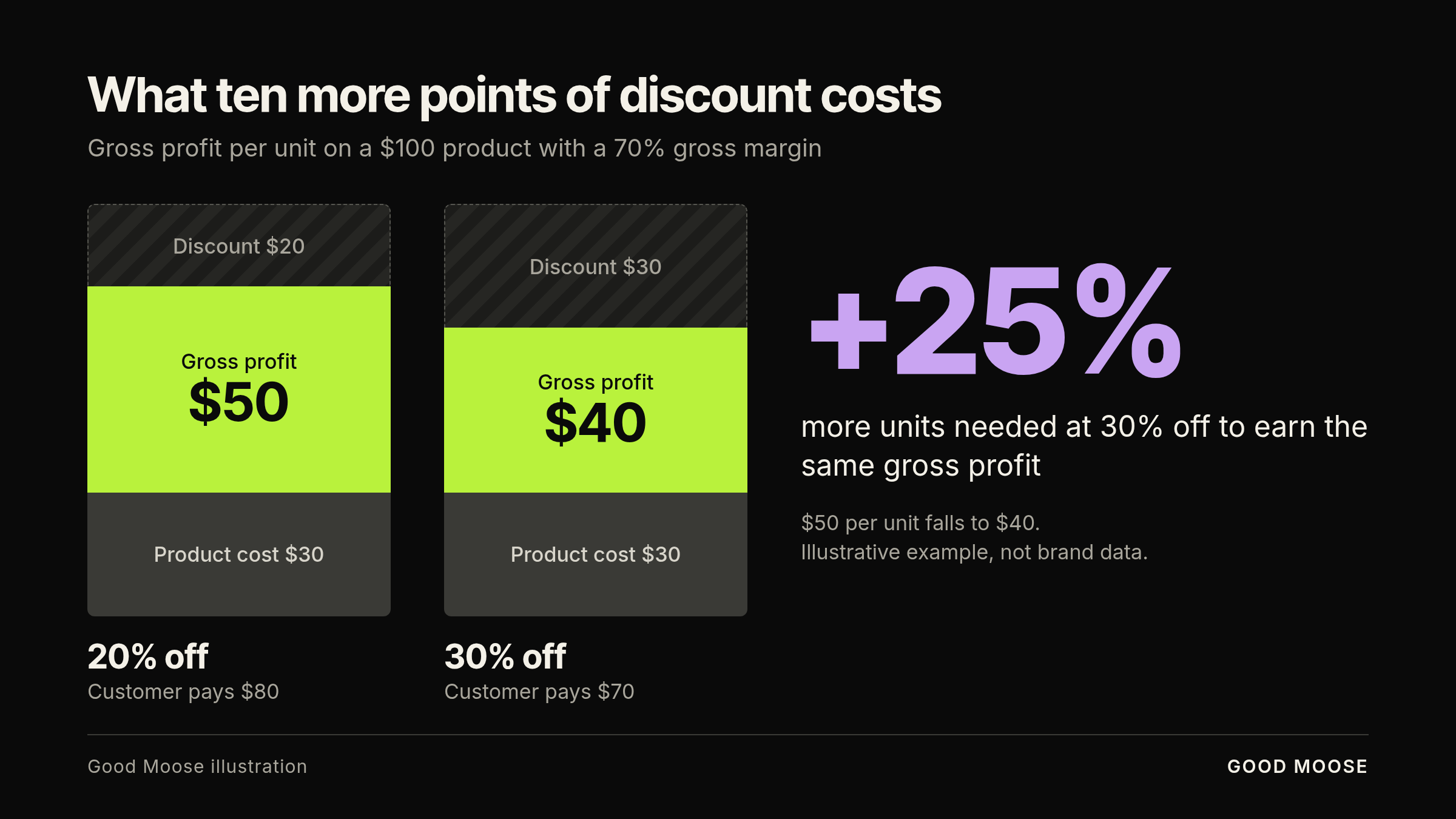
Illustrative margin math on a $100 product with a 70% gross margin, not brand data.
Messaging strategy 2: Put the deeper number on bundles and sets
The message: Deeper savings reserved for routines, sets or kits of several products.
Who led with it: Biossance paired 30% off sitewide with 40% off bundles. Kosas offered 25% off sitewide and up to 40% off sets. Merit advertised up to 32% off sets, The Inkey List 40% off routine sets for its Insiders members, and DedCool 25% off sitewide with 30% off The (Almost) Everything Set.
Why brands use it: It fits brands with a clear routine story (cleanser, serum, moisturizer) or products that work better together. The deeper percentage is visible, but it lands on a larger order.
The cost behind it: Bundles need inventory and packaging planning, and a set that mixes slow sellers with heroes can feel like a clearance box. Sets work best when they are curated around a real use case.
Messaging strategy 3: Reward the basket with a free gift
The message: A free product, mini or accessory once the cart reaches a set threshold.
Who led with it: Living Proof offered a free full size Dry Shampoo on orders of $90+, Gisou a free Honey Infused Lip Oil at $70+, Color Wow a free Bum Bag at $75+, Patrick Ta a free Blush & Balm at $150+ and Tata Harper a free 7 piece set at $250+.
Why brands use it: It protects the headline price and puts products in customers' hands that they may buy again. A gift costs its product cost (plus fulfillment), not its retail value, and a good one can become the next replenishment order.
The cost behind it: The threshold has to sit just above typical order value. Too low and the gift goes to orders the brand already had. Too high and few shoppers reach it.
Messaging strategy 4: Layer two or three levers
Several of the most structured offers we tracked combined two or three levers: a clear headline discount, deeper value on sets and a gift at a threshold. Kosas, Biossance, Summer Fridays (20% off plus a free travel case at $75+) and Dieux Skin (20% off, or 25% off orders of $125+, with a free Pocket Moisturizer Duo at $85+) all followed this pattern.
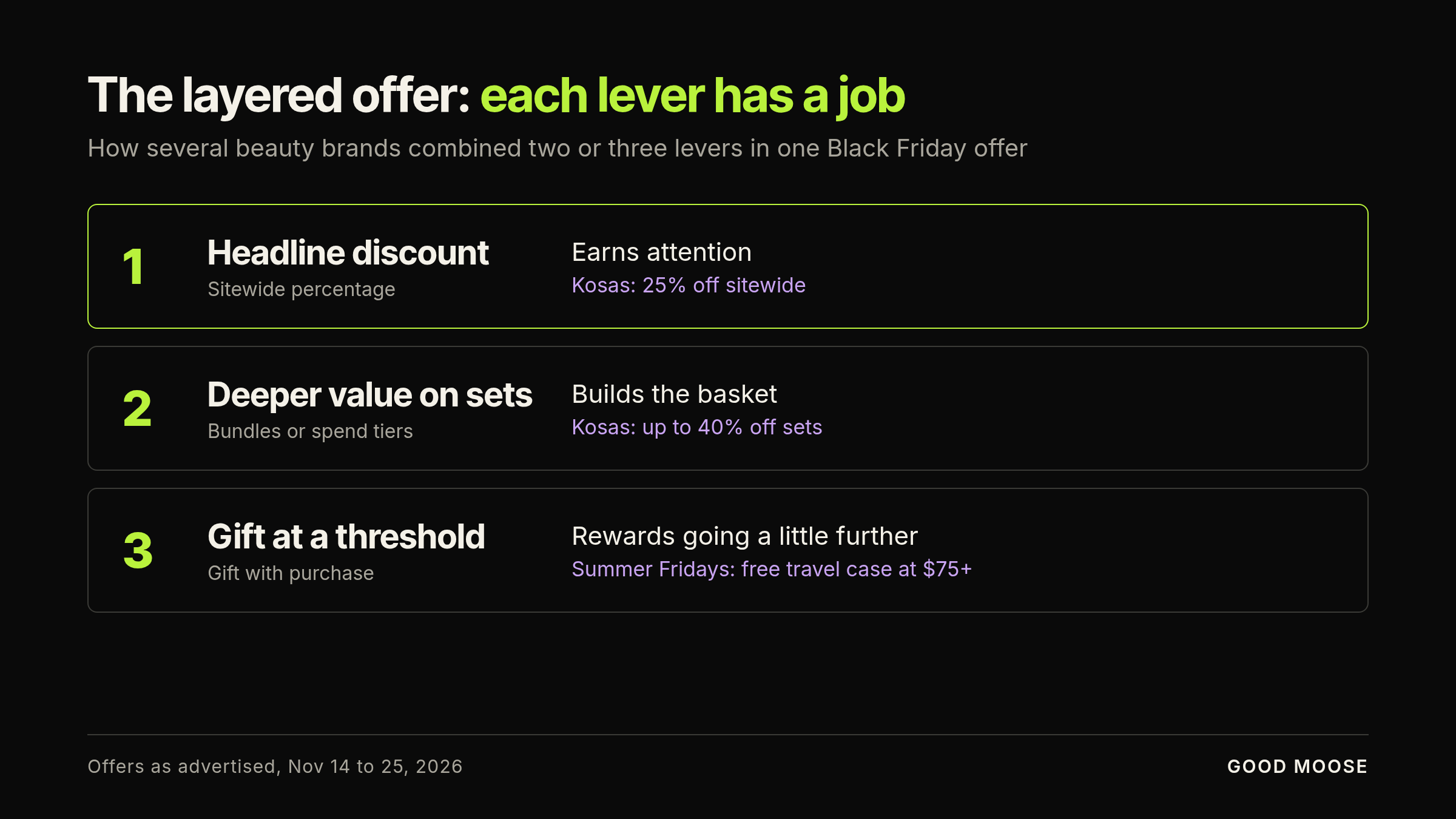
Examples reflect offers as advertised, Nov 14 to 25, 2026.
Spend tiers push the same idea further by rewarding bigger baskets with bigger savings. OneSkin, for example, offered 20% off orders of $149+, 25% off $225+ and 30% off $300+.
Our read: Layering gives each part of the offer a job. The headline earns attention, the set builds the basket and the gift rewards the shopper for going a little further. For growth marketing, it also gives beauty brands more than one creative angle to test. The observations show the mechanics, not which structure converted better.
How the messaging shifted through the week
Going into Thanksgiving, headline discounts held steady in the 20% to 30% range. Rather than raising discounts, brands added value through gifts and spend thresholds.
Timing was part of the message too. Early access messaging peaked earlier in the week and fell sharply on Thanksgiving morning as brands switched to public Black Friday banners.
What each messaging strategy signals to shoppers
| Messaging strategy | Core promise | What it protects or builds |
|---|---|---|
| Sitewide percentage | Everything is on sale | Reach and simplicity |
| Bundles and sets | Build your routine for less | Order value |
| Gift with purchase | Spend a little more, get something free | The headline price |
| Spend tiers | The more you spend, the more you save | Basket size |
| Early access | You get in first | Loyalty and momentum |
What this means for growth marketing at beauty brands
- The headline number is not the differentiator. Beauty headlines held at 20% to 30% sitewide in our tracking, so going deeper overnight is rarely what sets an offer apart.
- Deeper numbers belong on sets. They read as generous while landing on larger orders, aiming to capture a higher average order value.
- Gift thresholds should come from your own data. Aim slightly above your current average order value, and count the gift's product and fulfillment cost.
- Late changes added value, not discount. Going into Thanksgiving, brands added gifts and spend tiers, while the discounts stayed anchored where they were set ahead of time.
- The switch to public messaging happens fast. Early access messaging dropped sharply on Thanksgiving morning, so banners, email and ads need to change on the same day.
Quick answers
How much are beauty brands discounting for Black Friday 2026?
Mostly 20% to 30%, and that range held steady going into Thanksgiving. Only about 36.5% of the beauty offers we tracked relied on a flat sitewide percentage alone. Treat the range as a pattern among tracked brands, not a recommended discount for yours.
How are beauty brands using free gifts with purchase?
As a reward for reaching a spend threshold. Among the brands named here, thresholds ran from $70 at Gisou to $250 at Tata Harper, with full size products, accessories and sets as the gift. Judge a gift by what it costs you in product and fulfillment, not by its retail value.
About the data
This article uses DTC Calendar homepage observations from November 14 to 26, 2026. Percentages describe the share of advertised offers by format among tracked brands, not a census of every beauty brand.
Brand examples come from our snapshot of 30 beauty brands, observed November 14 to 25, and reflect offers as advertised during that window. They were not rechecked against brand websites on November 26. Discounts and terms may change, so check each brand's website for the latest offer. Strategic interpretations are Good Moose's analysis, not measured brand results. Naming a brand here does not imply its endorsement of this analysis.
Build the offer into your wider Cyber Week plan
This article is part of our Cyber Week 2026 series, analyzing promotional insights from more than 1,600 beauty brands tracked by DTC Calendar. The first looked at what DTC promotions data says about Black Friday beauty strategy. The second examined how beauty brands prepare for Cyber Week. The third compared Black Friday and Cyber Week 2026 deals from 30 beauty brands. For offers across other categories, see DTC Calendar's Cyber Week 2026 best deals across selected categories.
Good Moose is an independent growth marketing agency in New York working with beauty and consumer brands across direct to consumer and retail. If you want help shaping the message behind your next sale, read some of our case studies or get in touch.