What DTC Promotions Data Says About Cyber Week 2026: Beauty Brands Play by Different Rules
By Daniel Romano, Founder & CEO, Good Moose · Updated
The most important part of our work at Good Moose, a New York growth marketing agency for beauty and consumer brands, is being strategic partners to our brands so they can grow in a profitable way, especially during critical moments like Cyber Week. As part of our preparation for Cyber Week 2026 (Black Friday through Cyber Monday), together with our partner DTC Calendar, we analyzed promotional behavior across more than 14,000 brands, primarily serving the US market (see About the data below).
The interesting finding of 2026 was that during October, the broader market went quiet. Promotional activity fell sharply across the 22 categories DTC Calendar tracks. But a few categories kept building when others were reducing their activities: Beauty, Hair Care, and Personal Care. Below is what the data shows and how we would adjust paid media and creative going into Cyber Week to grow revenue without giving away margin.
Key takeaways
- In October 2026, recorded DTC promotions fell 28.8% and product launches fell 23.5% across 14,000+ brands tracked by DTC Calendar.
- Beauty, Hair Care, and Personal Care went the other way: launches rose 3.9%, growing from 15.2% to 20.7% of all recorded DTC launches.
- Beauty alone recorded 2,606 promotions in October, the highest count of any category tracked by DTC Calendar (Apparel was next with 2,580).
- About two in three clearly stated percentage discounts fell between 10% and 29% off. Our recommendation: compete on gift with purchase, tiered thresholds, and routine bundles rather than deeper discounts.
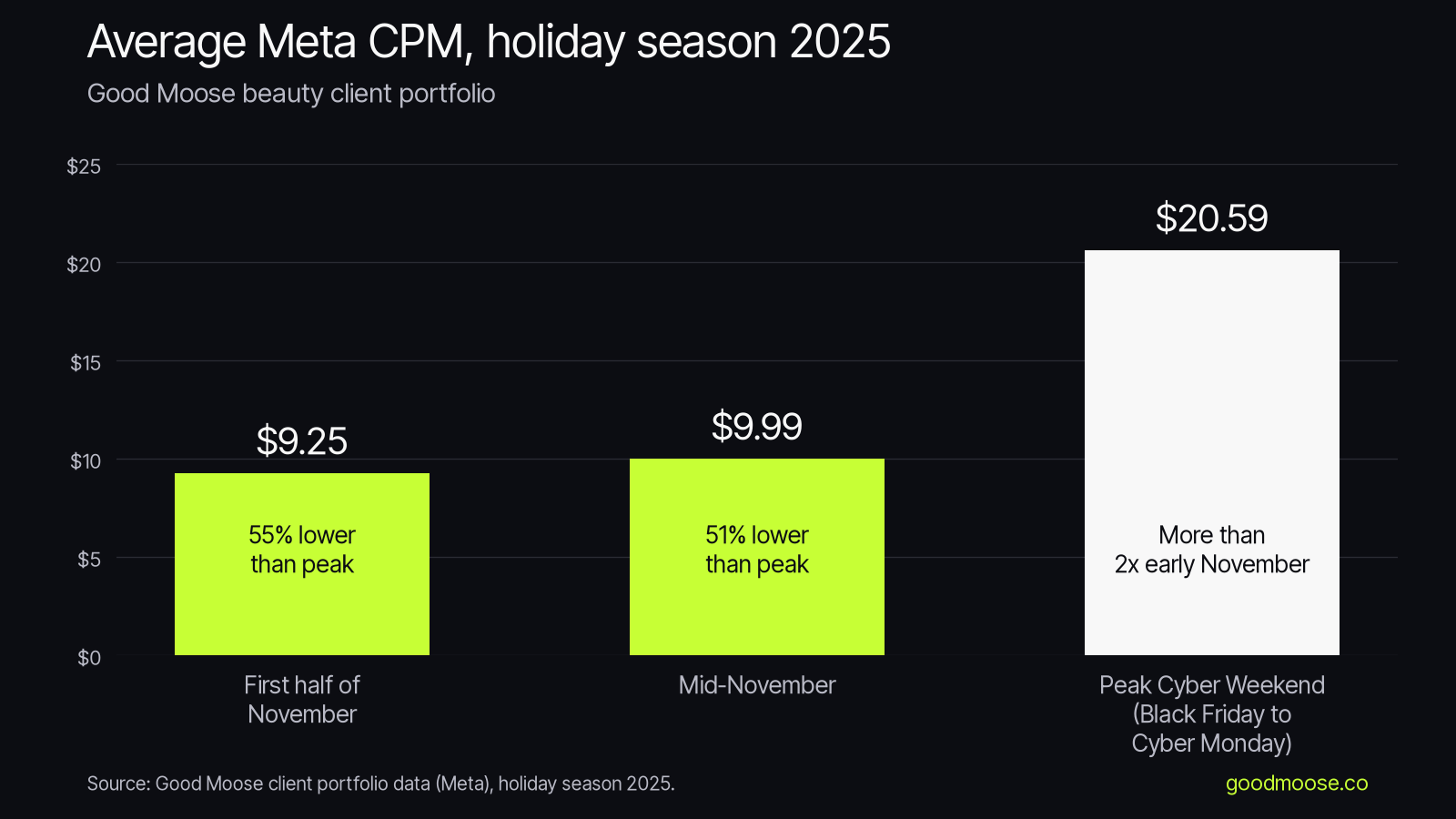
- In the Good Moose beauty portfolio, Meta CPMs averaged $9.25 to $9.99 in the first half of November 2025 and $20.59 at peak Cyber Weekend, which is why we recommend building retargeting audiences early.
Finding 1. The market went quiet. Beauty kept launching.
According to the DTC Calendar Industry Benchmark for October 2026, across the 14,000+ brands monitored, newly recorded promotions fell from 20,809 in September to 14,809 in October, down 28.8%. Recorded product launches dropped from 6,867 to 5,253 (down 23.5%). Apparel promotions dropped 38.0%, Health & Wellness 37.1%, and Home 30.5%. (Note: While part of the percentage drop reflects the two-day analysis gap and crawl timing, the directional pullback across the broader market is clear.)
But beauty brands went the other way. Launches across Beauty, Hair Care, and Personal Care rose from 1,045 in September to 1,086 in October, up 3.9%, growing their share of all DTC launches from 15.2% to 20.7%. Beauty promotions fell 15.2% (from 3,072 to 2,606), roughly half the wider market's 28.8% drop, which put Beauty alone ahead of Apparel (2,580) as the single highest promotional count of any category tracked by DTC Calendar.
September vs. October 2026 at a glance
| Metric | September 2026 | October 2026 | Change |
|---|---|---|---|
| Promotions first recorded (all categories) | 20,809 | 14,809 | -28.8% |
| Product launches recorded (all categories) | 6,867 | 5,253 | -23.5% |
| Beauty, Hair Care and Personal Care launches | 1,045 | 1,086 | +3.9% |
| Share of all launches from Beauty, Hair Care and Personal Care | 15.2% | 20.7% | +5.5 pts |
| Beauty promotions (Beauty category only) | 3,072 | 2,606 | -15.2% |
| Average clearly stated percentage discount | 23.9% | 24.5% | +0.5 pts |
Source: DTC Calendar Industry Benchmark, October 2026 report. Totals cover all 22 tracked categories. Promotion analysis was unavailable on October 24 and 25, so October counts are incomplete. See the methodology.
The timing looks deliberate. For beauty brands, October is the launchpad for holiday gifting. DTC Calendar recorded advent calendars and holiday vaults from more than 20 beauty, hair care and personal care brands in October alone, from e.l.f.'s $95 countdown box and Benefit's 24 day Hotel Beneville advent calendar to Glow Recipe's $150 Korean Glass Skincare vault. Our read is that brands use the month to test demand on holiday SKUs and seed creator buzz, so that by the time Cyber Week CPMs spike, the hero product can already have organic proof behind it and retargeting audiences are large enough to keep converting.
Finding 2. Everyone is running a similar discount
Among promotions with a single, clearly stated percentage off, the market average discount was 23.9% in September and 24.5% in October 2026. In October, about two in three of those offers (66%) sat between 10% and 29% off, like TULA Skincare's 25% off sitewide for Friends & Family or dpHUE's 25% off for National Hair Day. About 11% went to 50% off or deeper, and in the beauty examples we reviewed, those deep discounts were rarely sitewide. Meet Blume and Biossance confined 50% savings to routine bundles and limited edition holiday sets, protecting baseline margins while expanding basket size.
| Stated discount (October 2026) | Offers recorded | Share |
|---|---|---|
| Under 10% off | 36 | 3% |
| 10% to 19% off | 431 | 36% |
| 20% to 29% off | 368 | 30% |
| 30% to 39% off | 170 | 14% |
| 40% to 49% off | 74 | 6% |
| 50% off or more | 135 | 11% |
Source: DTC Calendar Industry Benchmark, October 2026. Based on 1,214 offers with a single, clear percentage discount; ranges, "up to" offers and dollar-off offers are excluded. Shares are rounded.
The bottom line: when your offer looks identical to your competitors', the ad platforms have less to differentiate you on, which can put upward pressure on customer acquisition costs. In a market where most offers sit in the same range, a deeper discount alone is unlikely to set you apart.
Finding 3. The beauty playbook: compete on offer structure, not deeper discounts
These are the recommendations we give our beauty clients. Results will depend on each brand's margins, audience and creative.
- Gift with purchase over a deeper discount: Rather than jumping from 20% to 30% off sitewide, consider keeping the cash discount at 20% and attaching a full-size hero or a deluxe mini duo to qualifying carts. Morphe did this in October: a free limited-edition gift on orders over $98, laddering to a free full palette on orders over $125.
- Tiered thresholds that encourage basket growth: A single $30 lipstick at 20% off can lose money after pick, pack, and shipping. Build spending tiers that increase average order value while protecting margin. In our experience with beauty brands, larger baskets can help absorb higher customer acquisition costs during peak holiday periods. Meet Blume packaged a 5-piece regimen valued at $192 for $95, turning each order into a $95 cart.
- Lead creative with newness, not discount banners: Blanket price cut ads are easy to tune out. In our client testing, limited edition sets, holiday packaging, and seasonal exclusivity have often delivered stronger engagement and conversion efficiency than generic discount banners. On October 12, Kosas launched its dedicated Holiday Shop without offering a single dollar off sitewide. Instead, it packaged 2026 bestsellers into pre boxed, giftable sets and dropped new seasonal shades for heroes like Soulgazer Mascara and Cloud Set Powder, positioning itself for full margin gifting sales weeks before Thanksgiving.
How beauty brands should plan paid media for Black Friday and Cyber Week 2026
Build retargeting pools before the auction gets expensive. Across the Good Moose portfolio of beauty brands, Meta CPMs averaged $9.25 from November 1 to 10, 2025 and $9.99 from November 11 to 21, versus $20.59 during peak Cyber Weekend.
| Period (holiday season 2025) | Average Meta CPM | Compared with peak Cyber Weekend |
|---|---|---|
| November 1 to 10 | $9.25 | 55% lower |
| November 11 to 21 | $9.99 | 51% lower |
| Peak Cyber Weekend (Black Friday to Cyber Monday) | $20.59 | Peak |
Source: Good Moose client portfolio data (Meta), holiday season 2025. Averages are blended CPMs: total spend divided by total impressions across the portfolio, multiplied by 1,000.
In our Facetheory Cyber Week case study, scaling awareness and top of funnel traffic ahead of peak let CRM and retargeting convert at scale. Cyber Week 2025 CPA on Meta and Google was 24% lower than in Cyber Week 2024, and paid media revenue on those channels finished 25% above goal.
Plan for auction inflation on every channel. In our portfolio, Meta CPMs more than doubled during peak Cyber Weekend 2025 as brands competed for the same feeds. Using peak days to prospect for new audiences is likely to cost you contribution margin. This is why our holiday playbook spreads spend across Meta, Google, TikTok, and retail media, as we did over four years of holiday work, described in the Sol de Janeiro case study.
Pull spend forward. In the Good Moose beauty portfolio, we have typically seen self-gifting and routine replenishment rise 3 to 5 days before Thanksgiving. Our recommendation is to move spend into the 10 days leading up to Thanksgiving and treat the Tuesday and Wednesday before as high volume conversion days, not soft warmups.
Expect creatives to burn out faster than usual. At peak spend, your best hooks can wear out in less than 48 hours. Have approved variants ready to swap in:
- Gifting: “The exact skincare set I am giving my best friend this year.” (Unboxing UGC showing the pre boxed packaging).
- Value math: “A $140 four step routine for $95: here is the math.” (Split screen price breakdown by product).
- Urgency: “Our limited holiday batch is live. Once it sells out, it will not restock.” (Warehouse or low inventory alert).
- Social proof: “The award-winning formula behind 10,000 five star reviews, now in a holiday vault.” (Press quote or review overlay).
Set up retention before Cyber Week ends. Acquiring a new beauty customer at breakeven can be a sound trade if their routine brings high margin reorders over the following months. Schedule email flows for Day 14 and Day 28 with regimen pairings, usage tips, and a bounce back offer before January.
In conclusion: profitable scale beats vanity revenue
While much of the market went quiet in October, beauty brands kept launching and promoting, building demand and audiences ahead of the most expensive week of the year. In our view, Cyber Week 2026 is less likely to be won by the biggest discount than by the brands that show up with warm audiences, an offer built to protect contribution margin, and creatives that sell gifting and newness.
About the data: Market figures are derived from the DTC Calendar Industry Benchmark (October 2026 report, published November 2026). DTC Calendar tracked 14,440 DTC websites at the end of October across 22 categories, from Beauty, Apparel and Home to Pet, Fitness and Cookware. Each promotion or launch is counted once, on the date DTC Calendar first observed it on site, so counts are detection dates rather than confirmed campaign start dates. Average discounts include only offers with a single, clear percentage off. The benchmark is not a census of all DTC brands, and promotion analysis was unavailable on October 24 and 25, 2026. Full details are in the methodology, and DTC Calendar's companion analysis is Cyber Week 2026 Promotion Benchmarks: Beauty Overtook Apparel Across 14,000+ DTC Brands. Paid media figures come from Good Moose client portfolio data. DTC Calendar is a Good Moose strategic partner.
Work with Good Moose
Good Moose is an independent growth marketing agency in New York working with beauty and consumer brands across direct to consumer and retail. Learn more about our work as a beauty performance marketing agency.